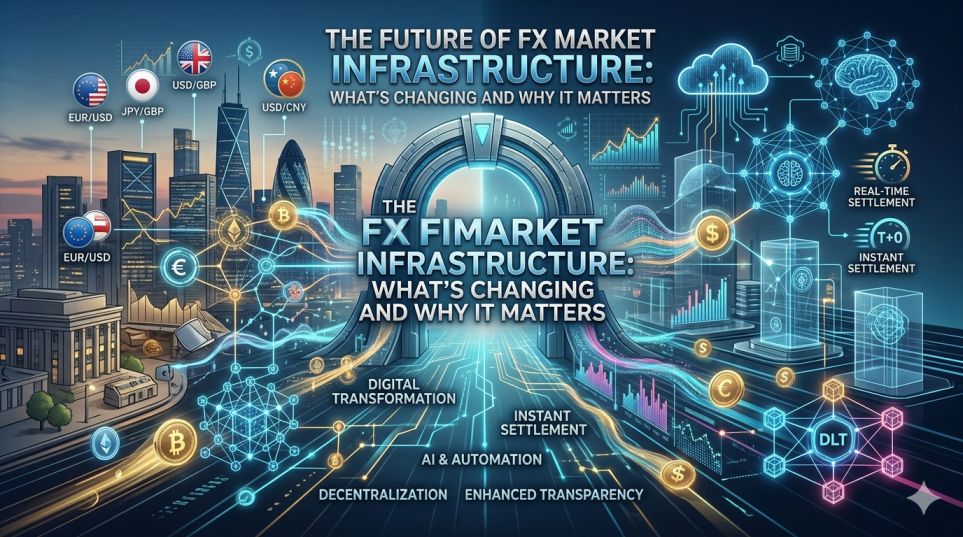
The infrastructure that underpins the global foreign exchange market is going through a transformation that most people outside the industry probably dont notice. Most of the attention in FX tends to focus on trading strategies, regulatory changes and new product launches. But the plumbing that actually makes everything work is changing in ways that will have significant consequences for every participant in the market from the largest institutions down to retail brokers.
Thank you for reading this post, don't forget to subscribe!For a long time the FX market ran on infrastructure built around the major dealing banks, interbank platforms and voice broking. Electronic trading gradually took a larger share but the fundamental structure stayed more or less the same. What is happening now feels like a more substantive shift driven by technology improvements, regulatory pressures and evolving market dynamics all working together.
Electronic Execution Keeps Evolving
Electronic execution in FX is not a new thing at all. Platforms like EBS and Reuters have been around for decades. But the nature of electronic trading is changing. The latest generation of platforms goes well beyond basic price matching to include advanced execution algorithms, real-time analytics and sophisticated order types as standard features. What is perhaps more significant is that the barriers to accessing this kind of institutional-grade execution technology have come down substantially. Tools that used to be available only to the biggest banks and hedge funds are now within reach for mid-tier institutions and even some of the more sophisticated retail operations. The growth in NDF electronic trading has been notable, with platforms demonstrating that even products traditionally handled by voice can be moved to electronic execution successfully. This trend is gradually extending to FX options and swaps as well.
Post-Trade Is Getting Modernized
If execution infrastructure has been changing quickly then post-trade infrastructure has been moving even faster. Settlement, clearing and reconciliation processes that were historically manual and prone to errors are being transformed through automation. This is cutting operational risk and costs right across the industry.
One of the more significant developments is the push for shorter settlement cycles. The shift from T+2 to T+1 in equities has triggered discussions about doing something similar in FX. The foreign exchange market has its own unique settlement complications particularly around CLS and the global nature of trading but the pressure to reduce settlement risk is definitely there.
Collateral management has also become a much bigger focus. As regulatory requirements around margin have increased, being able to manage collateral efficiently across multiple counterparties and products has turned into a real competitive advantage. New platforms for automated collateral optimization are appearing and they are reducing both the cost and the complexity of meeting margin obligations.
Data Has Become Infrastructure
Data has always mattered in FX but its status as critical infrastructure continues to grow. Real-time and historical market data, transaction cost analysis and execution quality metrics have become indispensable tools for market participants at every level. The quality and breadth of market data available to traders has improved dramatically but expectations and regulatory requirements have risen in parallel. Regulatory reporting obligations have turned data management into a core infrastructure concern in its own right. Firms need to capture, store and submit enormous volumes of transaction data accurately and on time. Meeting these requirements has driven substantial investment across the industry.
Alternative data sources are adding yet another layer. Satellite imagery, social media sentiment, shipping data and numerous other non-traditional inputs are being folded into trading and risk management workflows. Managing this flood of information requires sophisticated infrastructure that many firms are honestly still in the process of building out.
The Move to Cloud
Cloud migration in FX infrastructure is accelerating noticeably. There was significant pushback initially from financial firms worried about security and latency but cloud providers have done alot to address those concerns. The advantages in terms of scalability, resilience and cost efficiency are becoming hard to argue against.
Cloud infrastructure is especially valuable for disaster recovery and business continuity. Traditional on-premise DR solutions were expensive to maintain and sometimes didnt perform as expected when actually needed. Cloud platforms offer near-instant failover and geographic redundancy at a cost that would be prohibitive to replicate in-house.
The transition does have its challenges though. Latency-sensitive applications still need careful architecture to meet performance requirements. And regulatory rules around data residency and sovereignty can complicate cloud deployments for firms operating across multiple jurisdictions, which in FX is most of them.
What Does This All Mean
The infrastructure transformation underway has real implications for everyone in FX. Large institutions face the challenge of moving from legacy systems to modern infrastructure without disrupting what they are currently doing. Smaller firms have an opportunity to access capabilities that were previously beyond there reach. And for the industry as a whole better infrastructure translates to more efficient markets, lower costs for participants and reduced systemic risk.
The pace of change is not going to slow down. If anything the combination of technological innovation, regulatory requirements and competitive dynamics will keep pushing infrastructure forward. Market participants who invest in understanding these changes and positioning themselves accordingly are the ones who will do best in the FX market as it continues to evolve.